

Switchable-selectivity gas sensing enabled by a functionalized-graphene microrod resonator
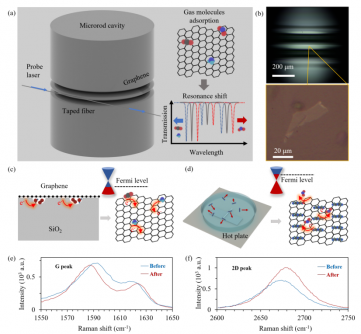
Figure 1 | Conceptual design of the switchable-selectivity gas sensor
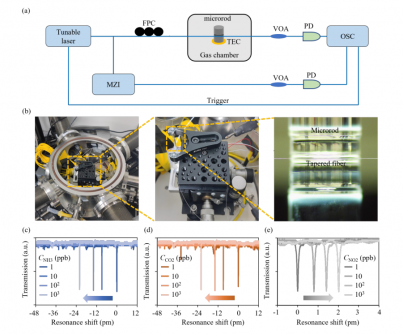
Gas sensing based on the graphene-integrated microrod resonator
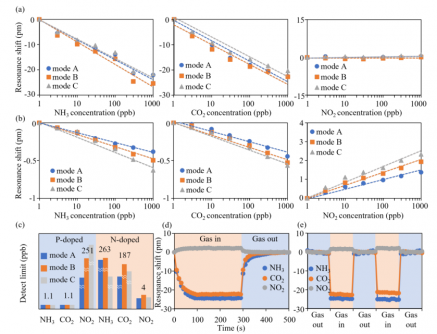
Performance of the switching-selective detection of gas samples
FAYETTEVILLE, GA, UNITED STATES, January 5, 2026 /EINPresswire.com/ -- Monitoring trace gases with high sensitivity and selectivity is essential for environmental safety and smart monitoring systems. Recently, a research team led by Professor Baicheng Yao from Key Laboratory of Optical Fiber Sensing and Communications, University of Electronic Science and Technology of China, has developed a simple, low-power optical gas sensor that uses functionalized graphene integrated onto a microrod resonator to detect trace gas molecules at ppb levels. By switching the doping type of graphene, the device achieves tunable selectivity among NH₃, CO₂, and NO₂, opening a new pathway for flexible, high-performance chemical monitoring.
Monitoring trace gases with high sensitivity and selectivity is essential for environmental safety and smart monitoring systems. Whispering-gallery-mode (WGM) optical microcavities have emerged as a powerful platform for such applications, owing to their ultrahigh quality (Q) factors and exceptional sensitivity to minute refractive-index changes. However, challenges such as Q-factor deterioration, complex mode analysis, demanding operation processes, and limited selectivity still remain, leading to intricate experimental setups, high excitation thresholds, and reduced device reliability and portability.
To address these limitations, the research team led by Professor Baicheng Yao from the University of Electronic Science and Technology of China designed and fabricated a graphene-integrated silica microrod resonator, establishing a compact platform capable of converting gas adsorption into measurable resonance shifts. The team prepared the microrod resonators through laser machining and obtained monolayer graphene via mechanical exfoliation, followed by precise integration of the graphene onto the microrod surface to ensure strong interaction between the cavity mode and graphene. In addition, they modified the doping state of the graphene through vapor-phase doping, and the Raman spectroscopy confirmed both its monolayer structure and its doping characteristics (Figure 1).
The researchers then constructed a tapered-fiber-coupled experimental system and placed the device inside a sealed gas chamber to quantify its resonance response to different gases. By exposing the microrod to calibrated concentrations of NH₃, CO₂, and NO₂, they monitored the wavelength shifts of multiple cavity modes and evaluated the concentration-dependent characteristics of each gas. Using this approach, the sensor achieved ppb-level sensitivity with a best detection limit of 1.1 ppb, while requiring only extremely low probe power, demonstrating its excellent gas-sensing performance. (Figure 2).
A major contribution of this work lies in enabling switchable selectivity through graphene doping engineering. Rather than altering the device structure, the researchers tuned the gas-sensing characteristics by converting graphene from P-type to N-type using diethylenetriamine (DETA). They systematically compared the sensitivities and detection limits of the two doping states for all three gases, demonstrating that P-doped graphene favors NH₃ and CO₂ detection, whereas N-doped graphene significantly enhances the response to NO₂. The team further verified the repeatability and recovery behavior of both configurations, confirming their suitability for long-term sensing applications (Figure 3).
With its simple construction, low-power operation, and doping-enabled switchable selectivity, the functionalized-graphene microrod resonator provides a versatile sensing platform for next-generation environmental monitoring, industrial safety assessment, and smart IoT systems.
References
DOI
10.1007/s13320-025-0772-2
Original Source URL
https://doi.org/10.1007/s13320-025-0772-2
Funding Information
This work was supported by the National Key Research and Development Program of China (Grant No. 2023YFB2805600), the National Natural Science Foundation of China (Grant Nos. U2130106 and 62305050), the National Postdoctoral Innovation Talent Support Program of China (Grant No. BX20220056), Guangdong Basic and Applied Basic Research Foundation, China (Grant No. 2024A1515011665), and the Industrial Key Project of China Southern Power Grid (Grant No. CG2100022001935673).
Lucy Wang
BioDesign Research
email us here
Legal Disclaimer:
EIN Presswire provides this news content "as is" without warranty of any kind. We do not accept any responsibility or liability for the accuracy, content, images, videos, licenses, completeness, legality, or reliability of the information contained in this article. If you have any complaints or copyright issues related to this article, kindly contact the author above.
